
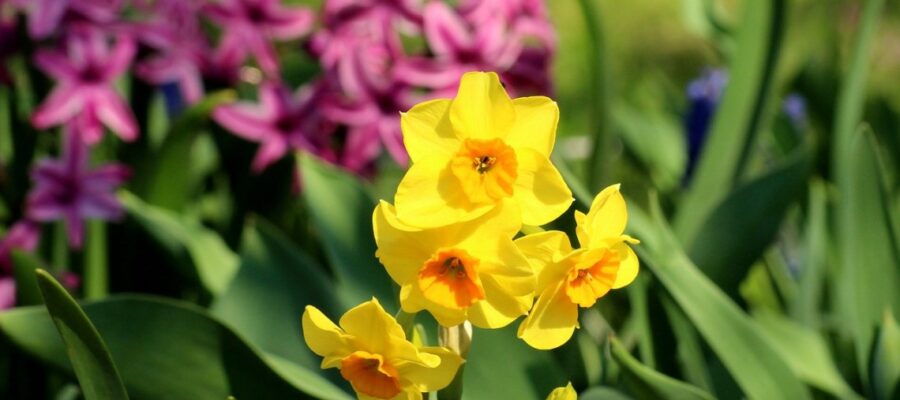
Narcissus generally appears in spring, Jonquille is a plant that announces sunny days. Unfortunately, its flowering is short -lived and is still adorable.
This flower is ideal in the edges, in vases and maximums, illuminates your gardens thanks to its beautiful gold color and Gaiezza Porta while the tulips have not yet come out.
In this article we explain the plantation of bulbs and the maintenance of this plant, easy to grow.
Presentation of jonquille

Originally from South Europe -Western, in particular in Portugal and Spain and Northeast Africa, this botanical species designates some herbaceous plants such as trumpet jaw or yellow narcissus. The real jaw is of the species Narcissus Jonquilla. In fact, this plant of light bulbs highly appreciated by the gardeners is also called «narcissus».
The species of wild nulls come from Europe or from the Mediterranean basin to the high mountains. It belongs to the Amaryllidaceae family. Make a lot of attention, its different parts are toxic. Moreover, Its perfume causes strong migraines.
Some varieties are of white colors and other yellow and white. The jaw of the trumpet has a kind of serrated stamp that perfectly justifies its name.
Very easy to sow, Jonquille resists frosts above -15 ° C, various diseases and insects of parasites. There is everywhere, this perennial, herbaceous and bulbous plant reaches 0.20 to 0.40 m in height.
Planting of jonquille

This announced spring system has several vernacular names Like Jeannette Yellow or False Narcisus. Narcissus likes in most gardens, but blooms better in the rich soil.
The best time to plant the bulbs is between the months of September and November. In this way, you can enjoy the rods at the end of winter or early spring. Narcissus appreciates sunny places, but can also adapt to an exposure to the partial shadow.
Several jonquille crops

Like all other plants, the jaw can be planted in the ground or in a pot. Each of these methods has its own advantage. Follow the details.
Cultivate a narcissus in the ground, Use a bulbs, a hand plant or a simple hoe. The pointed planter can cause a harmful air pocket under the bulb. Sow the bulbs, immediately after their purchases. Before then, you have to prepare the earth in advance. Remove the herbs, the stones to make them furnished. Dig a 20 cm deep hole with a spade. If your land is clay, add sand to promote drainage.
Plant each bulb 3 times the volume of the bulb and 10 cm deep, keeping the high end raised upwards. It is recommended to plant the jaw for a group of 8 or 10 minimums.
Only, each bulb must be spaced 5 cm. In the event that the light bulb tends to rise, it is better to bury it more deeply. This allows you to create graceful color activities.
If you want, vary exhibitions in the sun or in the partial shadow to get flowering in different periods, i.e. from February to May. Finally, cover with earth and sprinkle moderately.
This second technique is offered by florists during the winter. To start, choose the containers with a pierced background. This facilitates drainage. Put a layer of 5 cm of clay balls or small gravel in the lower part of the jar. So fill with suitable soil.
Plant the bulbs in order to touch the ground surface. Avoid holding them too much so that you don't touch. However, they shouldn't attack them on the edge of the pot because they can take cold. Moderate irrigation is more than enough.
How is it clear hydroponic?

This method is to adopt a waterproof and transparent container as a BAC or a vase, for example. Fill in pebbles, gravel, glass pearls or sand. Alternate these materials to create a more aesthetic set. Then place the bulbs in the 3 cm high mixture from the container. They must be well as followed and overcome in half.
Fill the container with water without covering all the bulbs. He only has to reach their base. Monitor this water level regularly so that it always remains at this height. Remember to add tutors if the stems are becoming high. This also helps to prevent the fold.
Narcissus is a plant that likes rich, deep and well drained soils. Too heavy and humid lands promote the emancipation of parasites. This flower needs heat. Therefore, it promotes sunny and repaired areas. Some varieties can resist until -15 ° C. Narcissus can remain in place for several years.
The best time to plant the narcissus is in autumn, that is, from September to November. In this way, the bulbs bloom the following spring.
Multiplication of the Jonquille

The flowers that have many seeds are in favor of spontaneous sowing. Know that the narcissus multiplies by division of bulbs in the summer. Proceed when the leaves begin to vanish.
This operation allows to quickly obtain new plants and promotes the rejuvenation of the mother plant. However, this multiplication mode is very long. This technique is reserved for horticulturalists Since it is necessary to wait for 3 and 7 years before the first flowering.
Here's how to multiply the narcissus. Undermate the bulbs using a fork. Take the bullies keeping the largest. Then prepare the sowing soil to make it clean and mobile. Transplant immediately the sampling bulbs, without forgetting to direct the tip. Cover and water.
Flowering Jonquille

In general, the Narcisus bloom from February to May. Its flowering is short -lived, that is to say 15 days at most. Its height varies from 8 to 60 cm depending on the variety.
As for the flowers, they consist of 3 petals and 3 sepal or 6 tepali in all. They can reach a diameter from 4 to 6 cm. The Narcissus Jonquille offers a delicious and unforgettable show, whether you put it in Rocky, Edge, Massif or Pot,
Jonquille interview

In the event that the temperature becomes cooler suddenly in the region where you live, protect the leaves of your plant using a wintering veil. Once the first leaves appear, do not hesitate to enter the jaw pots. Put them in a bright place. To bring a little more nutritious, add a small manure or a compost decomposed on the surface.
Unlike other plants, never add manure when you cry the bulbs. Remember grass regularly around your plantation. When the bulbs have flourished in their vases, they will no longer reflect in their containers. It is therefore necessary to transplant them in the ground in your garden.
Never cut the foliage of your plants. Let it become completely yellow. This technique promotes its recovery better the following year. In fact, the bulbs reform their reserves. On the other hand, you have to fold the stems of faded flowers.
Narcissus is a resistant plant, but it can rot if you sprinkle it too much. This is the same case in which the substrate or the ground are poorly drained. In prevention, you can put Bordeaux Porridge. This preparation allows you to fight against many bacterial and cryptogamous diseases. It is used in the vegetable garden, in the orchard and on the vineyard if you have them. Put it on the feet of plants in winter to avoid the manifestation of fungal diseases.
Pay attention to snails and snails who love bulbs. To reject them, Put a barrier of egg shells crushed around your plantation.
This technique naturally rejects these harmful gastropods. To attract the snails, arrange the surrounding bricks. Then, remove them by hand.
How to do the porridge of Bordeaux?
Authorized in biological agriculture, This product is a treatment with fungicide based on lime and copper sulphate. It is mainly used in the vineyards and is used in advance against Tavel, the bladder of fishing, mold, jewelry, gumosis, etc. Are you definitely wondering how to make this miraculous porridge? Here's how to do it.
In principle, this product is purchased in the gardens. But if you have a little air lime, you can create your own mixture. First of all, you need a 6 -liter water bucket and 300 g of lime milk. Mix using a stick. If you use a 15 -liter plastic bucket, 200 g of copper sulphate in 4 liters of water.
To neutralize the copper sulphate solution, slowly add lime milk. Always mix with the stick. Forget it 24 hours before starting to spray. Pour the porridge Bordeaux into the sprayer tank. If possible, work when the climate is completely dry.
Species and varieties of Jonquille

| Flowering | Size | Quality | |
| Species | Brilliant golden yellow. Flowering between March and June | 0.20 and 0.40 m in height | Used in beds, edges, barbells, in cut flowers and below —Bois. |
| Babby | Very brilliant golden yellow. Flourish in April and May | 0.25 m high | Very fragrant |
| Bell song | White and pale pink cream. Flourish in April, May and June | 0.30 m high. | Used in beds, planters, basins and cut flowers. |
| Hillstar | Brilliant and white yellow. Flourish in April, May and June | From 0.30 to 0.40 m in height | Pleasant perfume. Bunch flowering |
| Martinette | Yellow with bright orange spots. Flourish in April and May | From 0.30 to 0.40 m in height | Pleasant perfume. Bunch flowering |
| Pipt | Yellow cream and yellow lemon. Florling in March | 0.30 m in height | Lighter variety than the type species |
| Pueblo | Yellow with lemon, then white and ivory white. Flourish in March and April | 0.30 m in height | Very fragrant. Excellent cut flower |
| Quail | Golden yellow. Flourish in April | 0.35 m in height | Delicate perfume. Used in beds, basins and cut flowers (ten) |
| Simplex | Golden yellow. Flowering at the end of April | From 0.15 to 0.20 m in height | Many flowers for stem |
| Suzy | Pale yellow and orange. Flourish in April and May | 0.40 m in height | Very fragrant. Used in edges, bins and cut flowers |
| Solar disk | Storli gradient: lemon, cream, canary. Flourish in April and May | 0.20 m high | Delicately perfumed. Used in beds, edges, garden rockeries |
| Sweet ness | Pale yellow and orange. Flourish in April and May | 0.40 m in height | Very fragrant. Used in the edges, flowers and bins cut |
| Trévithian | Brilliant yellow. Flourish in April | 0.35 m in height | Very pleasantly perfumed |
- What plants to associate them?
In principle, the narcissus is planted in beds with perennial plants with summer or autumn flowering. However, you can also exchange the tufts between the deciduous shrubs or at the foot of large deciduous trees. Therefore, they find their conditions of their areas of origin.
Small botanical auctions are grown as rocky next to the coating. This allows them to be highlighted. If you put them in a pot, they marry tulips and hyacinths.
The flowers you cut at the beginning of the development last about ten days when placed in a vase. When you choose them, don't cut the leaves. They are necessary for the reconstruction of his reserves.
In case you have group plantations, It is necessary to loosen the bulbs every 3 years preferably in September. Jonquilles are essential plants in the gardens due to its ease of maintenance. In addition, they can resist until -15 ° C.
latest posts published

Alina island: in agriculture you have to be realistic

On the day of the open doors Saaten Union, in Drajna
The art of direct sowing – Mewi
Finally something simple: Fendone
Horsch in Agritechnica 2019: products created out of respect for nature
Fendt 500 Vario Series – tractors for four seasons
Peak technology for work in viticulture
Valtra celebrates putting intelligent solutions at the center of its development
Rauch Aero GT 60.1 – A single fertilizer distributor: economics, precision, efficiency