
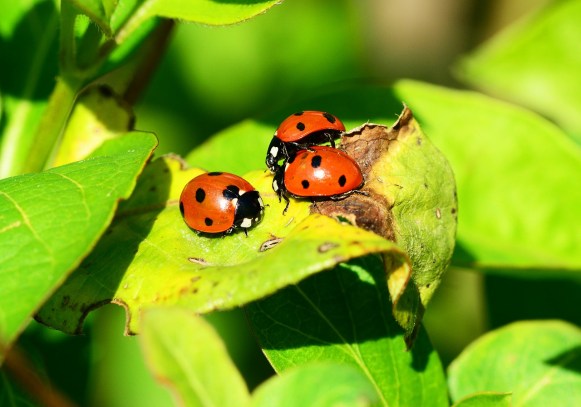
During the summer and also until the end of autumn, we see a parade of insects in our gardens, in the parks and almost everywhere we walk. And among these insects that turn in the air, there is the famous ladybug. An often red insect with black round spots.
If we often see them to satisfy us with flowers, leaves or branches of trees, what do we know about his diet?
What to know about the ladybugs

The ladybugs eat aphids but also larvae from other insects. However, depending on the variation of its basic diet, ladybugs can quickly change the rank. One of the reasons why we see them indulge in vegetative diets.
Although the plants or productions of the latter are rich in contributions, they are not sufficient for a ladybug. In addition, animal nutrients have more proteins than those of vegetable origin.
And proteins are essential for ladybugs. It is instinctive. They know that proteins are essential for their development and that there are enough proteins in the body of some insects.
Aphids

This is what a ladybug is generally eaten independently of the phase in which it is found: larvae or adults. These aphids find them on plants or in green places. It is the main food of the ladybug, but on condition only that the population of aphids is large enough for each of the ladybugs present can eat it at ease.
It is therefore necessary to take into account not only the population of ladybugs but also of the population of aphids. Why do aphids? Why These small animals are full of proteins, Indispensable for the growth of the ladybug. For example, these aphids allow you to accelerate the pose.
What if aphids are missing?

Which is quite probable in some cases. Even if the ladybugs prefer aphids to another diet, if missing, They are forced to eat with something else. And for lack of aphids, they will have to use a vegetable alternative. In this case, they therefore eat pollen or nectar.
It is only in case of reduction of aphids. However, the intake of protein will not be sufficient with these vegetable alternatives because the latter slows down growth and even stops eggs.
In addition to pollen and nectar, they also eat mushrooms that have a fairly alarming risk for some plantations. In fact, there are essential mushrooms for the growth of a plant and the ladybugs destroy this growth by eating all the mushrooms present.
A variable diet

If in general the ladybugs feed on aphids, they have a variable diet. So simple, We have predatory ladybugs that feed on aphids or larvae from other insects. These are the colorful ladybugs that we are often used to seeing. A diet that is the basis of their scalable success. Some of these ladybugs can eat up to 150 aphids per day.
Note that the variation in the regime depends on each species. Then there are So, called phytophagic ladybugs that feed on plants. They are also called potato ladybugs. Although they are very small, these ladybugs can cause fairly substantial damage to certain plant species.
After there is Coccinelle microfags that feed on mushrooms. There are ladybugs that feed on mites. We see them everywhere and it is a good thing because they are also getting rid of mites that are present in our homes.
And finally, There are ladybugs eating. The latter do not proliferate much and are limited to a few plant species.
An essential insect for a certain culture
Some species of ladybugs are essential for some growers and some plants. In, those who are beneficial for sowing tend above all to protect them. The ladybugs know what they have to eat and do everything to follow the diet assigned to their nature.
One of the reasons why their presence is beneficial for the cultivation of some plants. In addition, some growers should optimize the presence of these ladybugs because they help plants proliferate serenely without destroying all the harmful insects of your garden.
Some of them feed on toxins that alone are able to ingest without being able to die. They serve as alternatives as auxiliary organization in the protection of culture. They help to combat fans and cochenillary aphids. They are therefore good allies of organic agriculture.
The case of the Asian scarabeo

It is a species which feeds exclusively with aphids. It is a ladybug whose dimensions are quite large and resists its predators very well. Although at the base, the ladybugs are not fighting with each other, for the Asian ladybug it is quite worrying.
In fact, proliferate very quickly and it is of such voracity that it wants that aphids belong only to it. A behavior that is not noticed in other ladybugs. Consequently, due to its voracity, Asian ladybugs only want the soil for them.
So most of the aphids are assigned to them. One of the reasons why other species of ladybugs go looking for other foods.
In fact, the latter can eat aphids but Asian ladybugs tend to eliminate other species. Some ladybugs have decreased in number due to the behavior of the Asian ladybug.
Coccinelle for sale

The ladybugs are also found on the market. This is the reason why we find it in specialized stores. They can be sold by gardening centers or correspondence. In the egg phase, larval or adult, their diet remains the same. The 15 larvae sell about 10 euros, if you buy a lot of 100 adult ladybugs, for example, it will cost you in the € 70.
It is simply enough that we know which species belongs to adopting the appropriate diet. There are ladybugs that cannot fly. The latter therefore remain on the plants chosen and remain on the latter. This is often the case of Asian ladybugs. If you buy the ladybug at the egg stadium, the installation is rather delicate.
In fact, the eggs are rather fragile compared to larvae and adults. In this case, it is better to put the eggs near aphids. The larvae that will come out will immediately feed on these aphids. The larvae, being still fragile and weak, cannot travel long distances.
It is for this reason that you have to put aphids next to it. If you have to deposit larvae, be careful not to damage them. In this case he uses a brush. Put three to four larvae for shrub near a colony of aphids. Make sure each species is nourished with an adequate diet.