
Are you a gardening lover? Do you have a small vegetable garden? Do you want to enter the culture of asparagus? This article is for you.
Asparagus are a fairly robust plant that can live for several years. It is mainly composed of rhizomes and stems supplied with different branches that emerge from the ground. These are these stems, which are also known as Turiit, which are consumed.
Choosing to plant asparagus in your vegetable garden is a decision that must be made to know. In fact, asparagus are quite difficult to grow. It develops quite slowly. As for the type of soil, this plant requires a very sandy type of soil. Are you still leaving to undertake this adventure? Follow the leader.
The various varieties of asparagus

Did you know there are many varieties of asparagus? First of all, we have the «Super Argenteuil». This variety is an improved version of the traditional «Argenteuil». Like the latter, the «Super Argenteuil» is very recognizable by its mother -hpine. Then comes the «LARAC» variety. This stands out from the others for its very fleshy and quite early shifts.
You can also find the variety known as «Lima» which stands out for green, hasty and very vigorous stems. Finally, we have the «félias» variety that can give white or green consumable stems. It is always very early and is widely known to be very tasty.
You can also find asparagus purple. These are widely known in Italy and in the beautiful countries. There, these colorful asparagus are very popular for their typical tastes.
Although several classic asparagus are largely, they are grown in the same way. If the plantation of this quite special variety attempts you, you can find them in some specialized shops.
Prepared for the cultivation of asparagus

For this asparagal cultivation, you must choose a very furnished soil, rich in nutrients and above all well drained. It is strongly suggested to have a cultivable surface of at least 0.5 mx 1.5 m so that the rhizomes can develop well.
Asparagus are generally cultivable in March and April e theA harvest of consumer stems is from April to June.
Techniques and suggestions to cultivate asparagus

Although we are made to believe that asparagus grow only on sandy soils, they can develop completely on a clay soil. However, for these types of soil, it is much more difficult to extract the Turiit. In addition, asparagus require a fairly large area for development. Therefore, for 10 m2 of cultivable surfaces, An annual production of 5 kg of asparagus is obtained on average.
As for the color of the Turias, it mainly depends on the technique used by the gardener for sowing. Once ripe, the multiple claws of the plant see the gems that will be consumed. Once the latter emerges the ground, they take a purple color, therefore green. The sprouts can be fruitful or not depending on whether the plant is male or female.
Prepare your asparagus plantation

First of all, it is essential to prepare the ground well to plant asparagus. As mentioned above, it is advisable to have a well -transmitted cultivable surface. To get there, you will have to take your land. A The depth of 50 cm should be more than enough. By the way, do not forget to enrich the floor using compost or fertilizers.
Preferably, choose an organic product rich in phosphorus and potassa. It is useful to know that well prepared soil can be used for several years. Towards the beginning of March, an ideal month for the asparagus plantation, it is better to share your cultivable surface in different strips 40 cm wide.
Once this task has been carried out, it is therefore necessary to dig the trenches in which the claws will be planted. On average, Deep trenches from 15 to 25 cm. It is important to choose the right one depending on the type of soil. However, for green asparagus, it varies from 5 to 15 %.
As for the claws, it is more recommended to plant them directly after purchasing them. It is therefore better to look for them at the last moment. However, before guiding them in the ground, it is better to prepare them. How? Quite simply by cutting the pieces of the damaged roots, then applying coal powder so that they can heal better.
Once the preparation is finished, the sowing phase arrives. To help you in your task, place one tutor every meter and plant the roots at the feet of the latter. It remains only to cover the roots of 10 cm of earth. The tutors will act as a reference point once the collection period comes after 3 years.
A point of gardening is to place a mound on the asparagus cards towards the end of the winter period. Aims to stimulate claws from heat. However, this suggestion is valid only for white asparagus. For green, you simply replace the mounds with a plastic tunnel. To accelerate production, you can cover the roots with plastic tunnels since February.
How to collect asparagus?
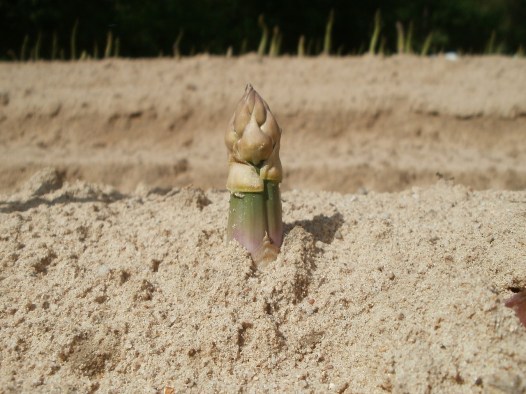
After more than 3 years of waiting and infinite, you can finally collect the fruit of your hard work. Well, you still have to wait until April. To do this, pass regularly through your little vegetable garden to identify the Turiit. Once found, it is not advisable to hurry their sampling. On the contrary, take your time and take very gently.
In fact, an excessively abrupt gesture could certainly hurt the claw to which the Turone is connected. The harvest must be done before asparagus can emerge. Otherwise, you will have asparagus of a purple color.
After three weeks of collection, You have to let the stems develop before cutting around the beginning of October. All you have to do is wait until the following year for a new harvest.
It is good to know that the surrender of an asparagus plantation is optimal from the sixth year. The land must be renewed every 15 years.
The precautions to be taken to protect your asparagus plantation

You must always protect your plantation from the various insects that can attack it. Among these, we can cite the asparagus fly that likes to dig the galleries in the shoots and then cause drying, or even the cryocère that feeds on the foliage and the Turiit. The best way to get rid of it is to eliminate them by burning the parts of the planting achieved.
What to do if shifts can be curved and blackened? Nothing because it is not a sign of a disease, it is just a consequence of the cold.