
The term «pétanque» derives from the words «Ped» which means «feet» and «so much» «stake». So, «Lou Jo a Péd Tanca» is the game with a foot or the game with the feet anchored on the ground, unlike the Provencal game in which the player is authorized to take on momentum.
This game would have been created, in 1907 in France in Marseille from Jules called «black».
Pétanque derives from the Provencal gamewith the following variants:
- It is on a shorter ground;
- The player throws his ball without taking a momentum;
- The player has his feet united and throws the ball from a circle traced to the ground.
In 1945, on July 31, the federation of Pétanque and French Provence games (FFPJP) was born.
The international federation of this same discipline was founded on March 8, 1958 in Marseille.
Pétanque, considered a traditional game, became a sport later. It was even decreed «high -level sport» in 2005 by the Ministry of Youth and Sport.
By the number of licenses identified, Pétanque is the tenth sport in France. It currently has 311,971 followers.
The equipment necessary to practice pétanque

The Pétanque game is also commonly known as balls of balls. Obviously, the balls are the main equipment necessary for this game.
- The spheres must be made of metal, in steel in most cases. THEThe conventional balls weigh between 650 and 800 gramsHave a diameter between 70.5 and 80 millimeters and a weight. There are versions adapted to small children. In this specific case, the balls are then made of plastic or wood.
- A wooden ball, also colored «cork», from the Occitan «Bocon», designates a ball. Sometimes it is also called «pork» or «small». It has a diameter of 30 millimeters.
Depending on the level of the players, there are two types of balls:
- Balls to play in free time
They are specially designed for occasional players. In order to adapt them to the hands and forces of all ages and sexes, the weight and diameter are the same. The weight is set between 600 and 800 grams. The production of this type of ball is governed by the NF Sttadino S 52-200.
Know that leisure balls are prohibited in competition.
- Balls to play with competition
To be authorized in competition, theThe balls must be approved by the FIPJP. They must also respond to the following characteristics:
- They must be made of metal and empty inside;
- The diameter of a competition ball must be between 7.05 and 8 centimeters for adults and between 6.5 and 8 centimeters for young people under the age of 11.
- A competition ball must weigh between 650 and 800 grams for adults and between 600 and 800 grams for young people under the age of 11.
- Each ball must present, clearly engraved on its surface, the sign of the manufacturer and its weight. The player can also customize his incision of his initials, his nickname and even his name and/or his name.
The earth
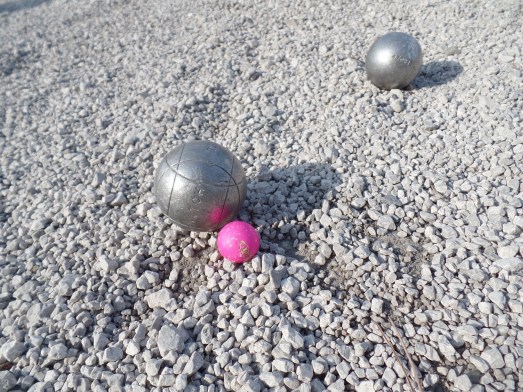
The game of the balls, pétanque, does not require specific soils. It can be practiced on different surfaces and in different conditions. But for competitions, the games take place on a drawn field called Frame. Officially, the maximum dimensions of a frame are 15 meters long 4 meters wide. At least, there will be 12 meters by 3.
How to build a pétanque field?

Any lover of Pétanque dreams of having his own playground directly at home. In the end, this dream could become reality because the production of the soil does not require great developments or disconcerting expenses.
For a very new handyman, the construction of its pétanque field is not such a difficult site.
Here are the steps to follow to do this:
- Preliminary passage: terrain development
Before starting the different stages of the construction, the first thing to do is identify the ground and see the available space. An area of 15 meters wide for 4 meters is sufficient for construction. But if your surface is smaller, depending on the possibilities, it is possible to adapt the size.
Once the size of the size has been resolved, you have to look at the ground level. If it is inclined, It is necessary to level.
- Step 1: Preparation of the soil
To start the job, you have to deliver the ground. You need to do it with a tracker cable and a ribbon meter.
The ground must therefore be disbursed on a depth of about 25-30 centimeters. Since the surface obtained must be flat, the operation must be performed with a shovel.
To finish this first step, it is necessary to remove the parasites, such as large roots and other obstacles, and flatten the bottom with the back of a rake so that the ground is equated.
- Step 2: the delimitation of the earth
On the well -equalized field, spread large gravel On a thick layer 5 cm ;
The ground is then leveled. This step is important because the update allows to obtain a flat surface and a straight land.
Above the gravel layer, place a geotassile canvas. This is very waterproof that it will prevent the development of parasitic roots. It also protects water from water and the risk of floods. Once the canvas is underway, your land is compact.
Throughout the field, place the beams. They must adapt symmetrically and perfectly with the rectangle shape of the soil. And on the length and in the corners, they must be repaired together.
A little advice: For greater solidity and stability, strengthens corners.
- Step 3: the update of the earth
You have to spread it A second layer from 10 to 15 centimeters in the thickness of the gravel Ends on the field. Depending on your needs and possibilities, it is possible to add 2 or 3 additional levels.
With a level rule, proceed with the leveling operation. Madam then the soil until you get perfect compaction.
Put into it just enough around the field. For greater solidity, use the Besting of autoclaves treated or, for a less expensive solution, the railways can also make makeup. Put them in symmetry because they will be the first to suffer the impact of the balls.
- Step 4: give the ground a rest time
Before permanently using the ground, spread 5 cm of sand or gravel stabilized on its surface.
While continuing to damage, humidify the ground. To obtain optimal leveling, use a vibrant plate.
Then leaves Rest your beautiful brand new land for at least 4 days.
After these four days of rest, renew the operation with the same doses, without forgetting to moisten the play area. Let it rest for one last time for at least 2 days.
And that's all! All you have to do is put the flip flops, put the glasses and hat. The first advantage can start.